
FEBRUARY 2024
my life with input devices
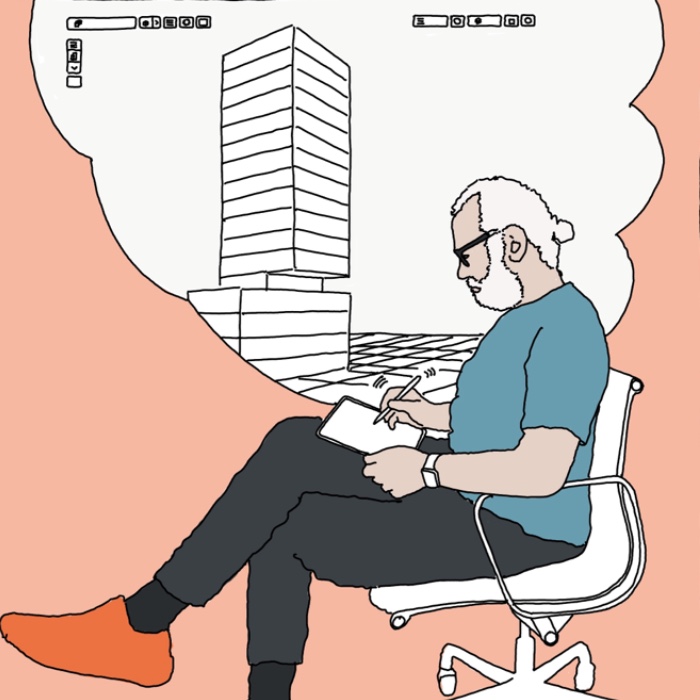
When I start as an architect, four and a half decades or so ago, I have no inkling that for much of that time my work will be done through input devices. At the time I don't realise I am using input devices; I call them pens and pencils, and their fluid movement is a natural extension of thought and action.
It is a novel and exciting time in the early eighties when I am introduced to my first electronic drafting input device. A digital pen connected by a wire to a computer, this InDe works with CAD software that I load from a floppy disc every time I want to use the system.
It looks like a pen, but it doesn't behave like a pen. Instead of the natural act of drawing, I use this InDe to pick points on a digitised rectangle. It is slow, with no fluidity of movement. I realise that to benefit I need to be able to make further use of the information I have so laboriously created. And thus is spawned my awareness of automatically created reusable additional data.
Graduating to digitisers and then mice I conclude that, no matter what InDe I use, 2D CAD is unlikely to give enough acrad to compensate for complexity of input and information management.
Enter 3D CAD. We settle on the mouse as the standard InDe. Still clunky, but the much greater acrad achieved by creating virtual buildings more than compensates.
Fast forward to September 2015 and the introduction of the iPad Pro. Using the Apple Pencil I am once again drawing with a fluid movement and, as the drawings are digital, I can edit and manipulate what I have drawn. I am getting acrad by simply sitting and drawing. How wonderful! This is an InDe to love.
But now I am following two paths. I get awesome acrad from my computer using BIM and the clunky InDe and, on the iPad, a seamless connection between thought and movement, as well some acrad return. Surely there is an app which can combine those alternatives?
I start looking for iPad BIM software. I first use SketchUp in 2002, but have followed my ArchiCAD path since. I consider Sketchup again as its iPad version is highly refined. But it works in a point-clicking rather than fluid manner.
Then by chance last year I have a look at Codesign. With that I can draw in a casual and fluid manner with my Pencil, and from that sketching I get a lot of acrad. As I'm drawing I'm seeing fully formed building envelopes appear, casting shadows in their context, with scale and data discreetly displayed.
If I wish I can go into a more detailed point click mode, and if I'm getting particularly focussed I can do dimensional input. But I don't have to.
Despite all the assistance AI and generative design will give us, we will still need to express our design thoughts. It could be that Codesign shows us a way of doing that in a way which allows us the ease and simplicity of sketching but with the result being a fully formed virtual built environment which can then be further analysed, assessed and enriched?
And while using it perhaps I can forget I am using an input device.